
2024 has been a transformative year for the Wildlife Justice Commission (WJC), marked by remarkable progress in our mission to disrupt and dismantle transnational criminal networks trafficking wildlife, timber, and fish. From landmark arrests and convictions to strengthened policy influence, we have taken significant steps toward our vision of a world free from wildlife crime.
Breaking new ground across continents
This year, our work expanded into new regions, with successful operations leading to significant seizures and arrests across Africa, Asia, and even marine territories. We dismantled 16 transnational criminal networks and disrupted the illegal wildlife trade on a global scale. Working closely with our law enforcement partners, we supported 84 arrests and facilitated major seizures in countries such as Nigeria, South Africa, Mozambique, Thailand, Malaysia, and Indonesia, as well as across South America and Southeast Asia.
Record seizures and landmark convictions
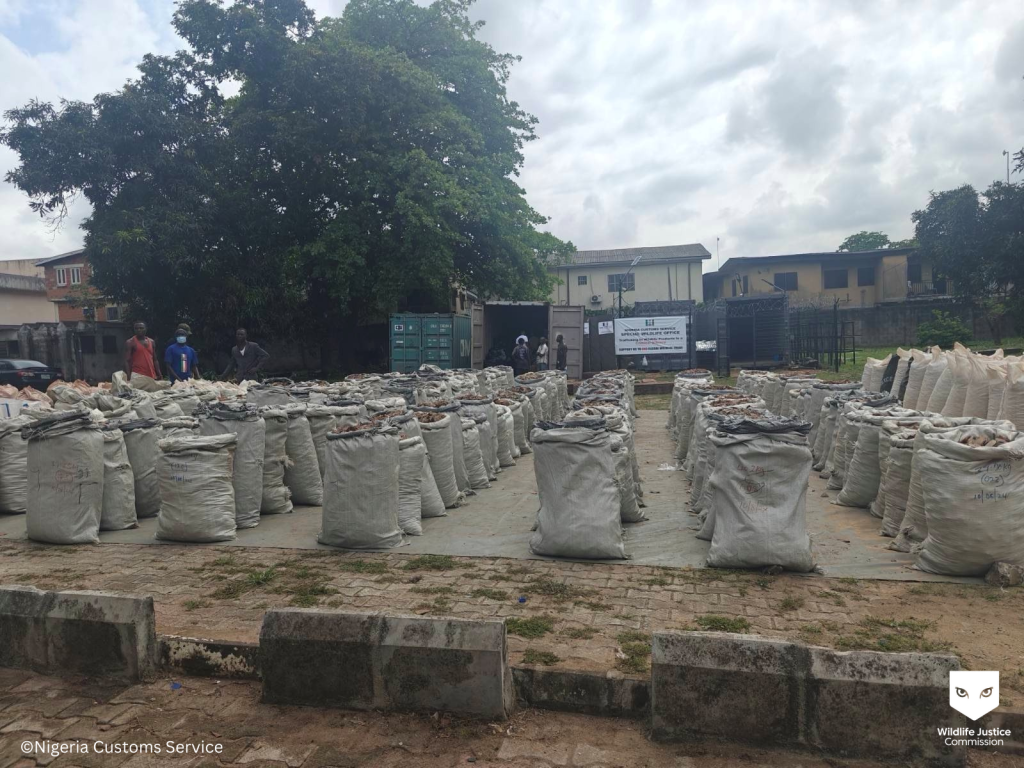
Our highly successful partnership with the Nigeria Customs Service (NCS) continued with our intelligence led investigations enabling record-setting seizures and arrests, such as the historic seizure of over 9.4 tonnes of pangolin scales in Nigeria – one of the largest single seizures of its kind.
The impact of this partnership has been profound. Since July 2021, the NCS-WJC partnership has been responsible for 95% of all pangolin scale seizures in Nigeria. Contributing to strengthened law enforcement action, we significantly disrupted Lagos-based criminal networks involved in trafficking ivory and pangolin scales in Nigeria, with trafficking activities almost ground to a halt today. This impact is evidenced by the absence of reported significant seizures of African pangolin scales at any seaport globally for over two years.

In Mozambique, our efforts played a key role in securing the convictions of Simon Valoi, aka “Navara,” and Paulo Zucula, notorious figures in the illegal rhino horn trade. Their arrest in 2022 by the National Criminal Investigation Service (SERNIC), with support from the WJC, and their subsequent conviction and sentencing respectively to 27 and 24 years marks a significant blow to wildlife trafficking networks across southern Africa. The high sentences send a strong and clear message to those involved in the illegal rhino horn trade that their actions will be met with severe consequences.
This decisive action underscored the power of targeted law enforcement and strong penalties, as the disruption caused by Navara’s conviction has contributed to a shift in rhino poaching activity. Once concentrated in South Africa’s Kruger National Park, poaching threats have been displaced to other parks, provinces, and countries in the region. Recognising this displacement, we are proactively taking steps to address these emerging threats, tackling wildlife crime head-on in our aspiration to make illegal wildlife trade a high-risk endeavor across the globe.

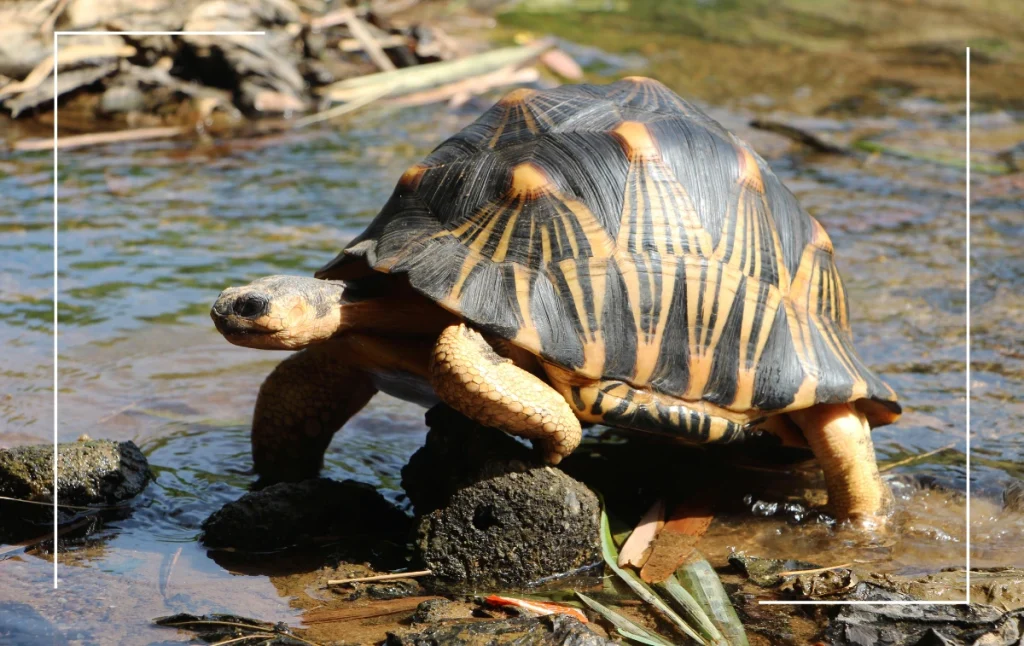
In Thailand, in May 2024, Thai law enforcement, acting on intelligence provided by the WJC, intercepted a four-vehicle convoy. Inside, authorities uncovered hundreds of radiated tortoises and dozens of lemurs destined for the illegal pet trade.
Further investigation led authorities to a nearby farm, uncovering more wildlife, including 179 tortoises, 30 primates, and juvenile crocodiles.
In total, the operation rescued 1,234 tortoises, 48 lemurs, 30 primates, and other endangered species—valued at over USD 2 million on the black market. This seizure revealed the staggering scale of the illegal pet trade, where animals like tortoises and lemurs are targeted for their rarity and sold to collectors worldwide. The success of this operation highlighted the power of international collaboration. Thai authorities, including the Department of Special Investigation (DSI) and the Natural Resources and Environmental Crime Suppression Division (NED) of the Royal Thai Police, worked alongside global partners like the United Nations Office on Drugs and Crime (UNODC), and the U.S. Fish and Wildlife Service (USFWS) and the WJC. At the other end of the supply chain in Madagascar, 4 individuals were arrested in follow up investigations. This operation culminated in the historic repatriation of critically endangered Malagasy wildlife in November 2024, marking the first return of confiscated wildlife to their native habitat prior to the conclusion of legal proceedings in Thailand. This was made possible through updated Thai laws enabling faster repatriation action.


Building political will
Building on our on-the-ground successes, the Wildlife Justice Commission made significant strides in raising awareness and influencing policymaking with our recommendations on how to effectively tackle wildlife trafficking by participating in high-level forums and contributing to key policymaking documents. We contributed to strengthening provisions for the protection of wild fauna and flora within the draft Council of Europe Convention on the protection of the environment through criminal law, set to open for signature in 2025.
At the 21st International Anti-Corruption Conference (IACC), we raised awareness about the role of corruption in facilitating environmental as well as converging crimes, such as drug trafficking, and called for enhanced anti-corruption measures to counter wildlife trafficking.
Our advocacy at the 12th meeting of the Conference of the Parties to the UN Convention on Transnational Organized Crime and 33rd session of the UN Commission on Crime Prevention and Criminal Justice (CCPCJ) underscored the urgent need for States to prioritise the fight against wildlife crime and implement binding international commitments to that effect, as well as to enhance collaboration with civil society and other partners.
This year, we expanded our efforts by engaging in two new forums, aiming to bring the crime perspective into conservation discussions. At the UN Ocean Decade Conference, we highlighted the urgent need to address the trafficking of vulnerable marine species for effective ocean governance, and we underscored the critical role of financial investigations in disrupting wildlife criminal networks and protecting biodiversity at the 16th meeting of the Conference of the Parties to the Convention on Biological Diversity.
We also deepened our partnerships with like-minded allies, strengthening our role as Chair of the UNCAC Coalition Working Group on Environmental Crime and Corruption, joining the Board of the Alliance of NGOs on Crime Prevention and Criminal Justice as Vice-Chair, and co-chairing the Alliance’s Working Group on Crimes that Affect the Environment. Additionally, we joined the “Let’s be Nice to the Ocean” civil society movement aimed at increasing ambition at the 2025 UN Ocean Conference in Nice, France.


Capacity building: Empowering local law enforcement
Equally important to our mission is our commitment to empowering local law enforcement agencies. This year, we conducted training programs across Mozambique, Thailand, and Botswana, aimed at strengthening investigative skills and fostering cross-border collaboration. By equipping local authorities with specialised skills, we are strengthening efforts to protect our planet’s wildlife.
We are proud to announce a groundbreaking agreement for an empowerment project in Mozambique, led by the WJC in collaboration with the Supreme Court of Mozambique. This initiative was developed alongside the Attorney General’s Office (PGR), the National Criminal Investigation Service (SERNIC), the Mozambique Tax Authority (AT), the National Administration for Conservation Areas (ANAC), the National Agency for Environmental Quality Control (AQUA), and the Environmental Police. The empowerment project is designed to significantly enhance the capability of state institutions to investigate and prosecute wildlife crimes more effectively and collaboratively, marking a major step forward in the fight against wildlife trafficking.

In 2024, the WJC also concluded Project Galvanise, a capacity-building initiative that strengthened law enforcement efforts against wildlife crime in Southeast Asia, focusing on the power of intelligence analysis. The project delivered over 40 intelligence reports to agencies in Vietnam, Thailand, Laos, Malaysia, and Indonesia, uncovering key links in the wildlife trafficking supply chain and identifying a major criminal kingpin.
Part of project Galvanise, we launched the Online Resource Centre for Analysis (ORCA), enabling collaboration among analysts from 16 countries and promoting best practices in tackling transnational wildlife crime. With this initiative, the WJC empowered local enforcement to disrupt criminal networks more effectively.
Raising awareness and sharing insights
Our work goes beyond operations; it’s about fostering understanding and support for the critical fight against wildlife crime. Our short documentary Seizure, part of Project Galvanise, premiered as a finalist at the Kuala Lumpur Eco Film Festival (KLEFF) in Malaysia. The film captures a team of WJC investigators as they follow criminal networks across borders as the last line of defence to combat the trafficking of the world’s most endangered species.
Seizure has earned multiple awards, including “Best Short Documentary” at the Activists Without Borders (UK) and Swedish International Film Festivals (Sweden), an Honourable Mention at the Lookout Wild Film Festival (USA), and an award of Outstanding Excellence at the Nature Without Borders International Film Festival (USA) and the Documentaries Without Borders International Film Festival (USA).
We were also honoured to be featured in Patrick Alley’s book, “Terrible Humans”, which spotlights our dedication to combatting wildlife crime. An entire chapter is devoted to our mission and investigations, drawing powerful insights from our team and their firsthand experiences.
Celebrating our donors and partners
None of this would be possible without the generous support of our donors, partners, and supporters. Every operation, training, and policy win is a testament to the collective dedication of our supporters. Together, we’re proving that it takes a network to defeat a network.
As we look to 2025, we reaffirm our commitment to disrupting and dismantling the transnational criminal networks trafficking wildlife, timber, and fish by collecting evidence and turning it into accountability so that organised crime is not driving species to extinction.
It’s a journey, but with each passing year and each victory, we are making a difference for wildlife.