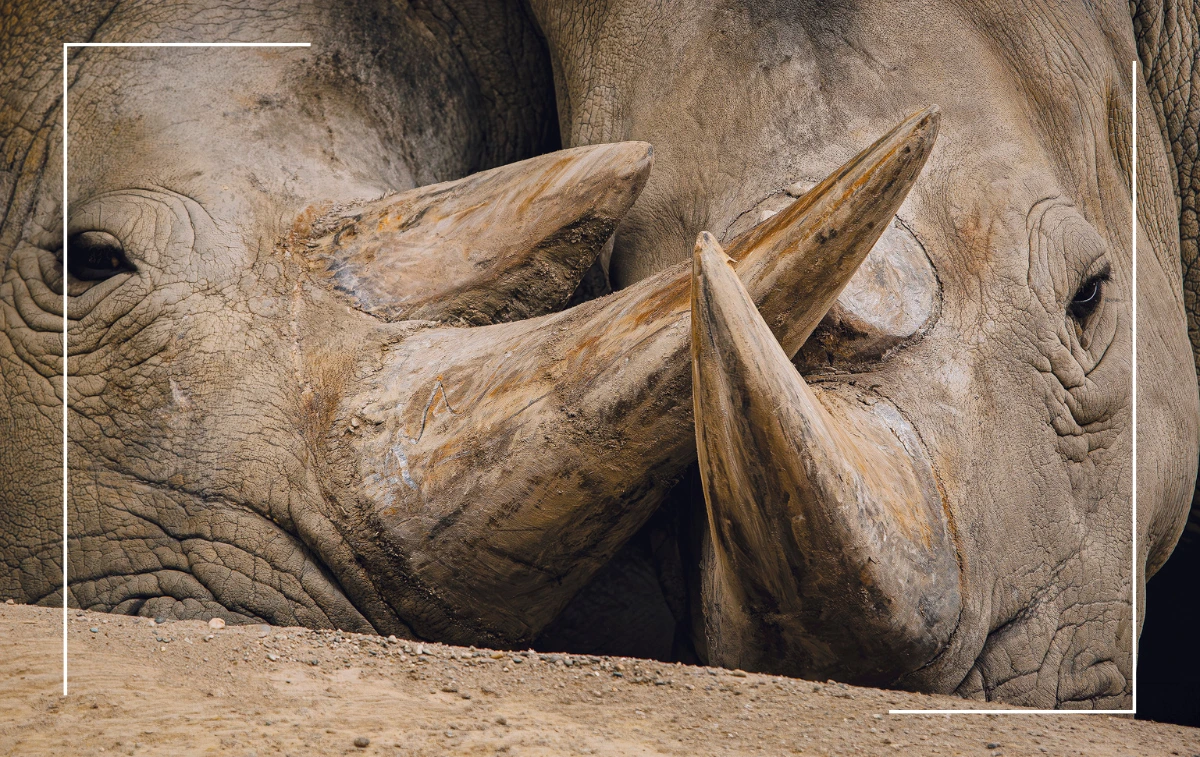
Every year on World Rhino Day, we are reminded that the very trait rhinos are known for—their horns—also makes them a prime target for wildlife traffickers, putting these iconic species at risk of extinction. But this year, there is a reason for hope: rhino poaching is declining.
In 2025, 352 rhinos were reported poached across South Africa, the epicenter of the crisis and home to the world’s largest rhino population. Although every rhino lost to poaching is a tragedy, this was the lowest level since 2010. It represents significant progress and shows that proactive, targeted law enforcement pressure is making a difference. The Wildlife Justice model of collaborating with law enforcement to target kingpins and disrupt their networks is working.
But disrupting trafficking networks is not the same as permanently defeating them. Our latest Snapshot from the field: Current trends in rhino horn trafficking, examines what is happening across the trafficking landscape and what it could mean for the future of rhinos.
The picture is complex. While poaching has declined, there were also signs of renewed activity in 2025. Our intelligence shows both why enforcement pressure works, and why that pressure must be sustained.
Rhino horn trafficking is not simply a conservation problem. It is a form of transnational organised crime. Criminal networks operate across borders, connecting poachers in Africa with brokers, transporters, and buyers in Asian markets. They move money, exploit corruption, build partnerships, and constantly adapt to reduce their exposure to law enforcement.
That is why our response must be equally adaptable. Our investigators can deploy within 24 hours and pursue their targets across national borders. Through our investigations, Wildlife Justice works closely with law enforcement partners to identify kingpins, infiltrate their networks, and generate evidence that can support arrests and prosecutions.
When trafficking bosses are arrested and convicted, the impacts ripple outwards. Networks lose their leadership, shipping routes collapse, and criminals go to ground. The perceived risk of participating in the trade increases.
Our intelligence shows that this has happened with rhino horn trafficking. Traffickers have told our investigators that law enforcement pressure is making it increasingly difficult to move rhino horn out of Africa.
But criminal networks do not simply disappear when one route is closed. They look for new routes, new partners, and new opportunities. And when enforcement pressure decreases, previously-disrupted networks can begin to rebuild their capacity.
That is why the decline in poaching cannot be treated as the end of the problem. Rather, it is an opportunity to build on what is working and maintain the pressure. The threat to rhinos remains serious, and criminal networks remain capable of adapting. But the decline in poaching demonstrates something important: proactive, targeted law enforcement pressure can suppress organised wildlife crime.
We know that disruption works. We know our approach is succeeding.
The task now is to sustain it. That means targeting the people who control trafficking networks, following financial flows, addressing corruption vulnerabilities, and strengthening cooperation between law enforcement authorities across borders. It means continuing to build intelligence as networks reconstitute and acting before new trafficking hubs become firmly established.
Success is not simply the seizure of another shipment or the arrest of another trafficker. Success is creating an environment in which wildlife trafficking becomes harder, riskier, and less profitable—and maintaining that environment over time. Rhino poaching is down, and the traffickers are feeling the pressure. But criminals don’t give up easily. Neither do we.