
October 2023
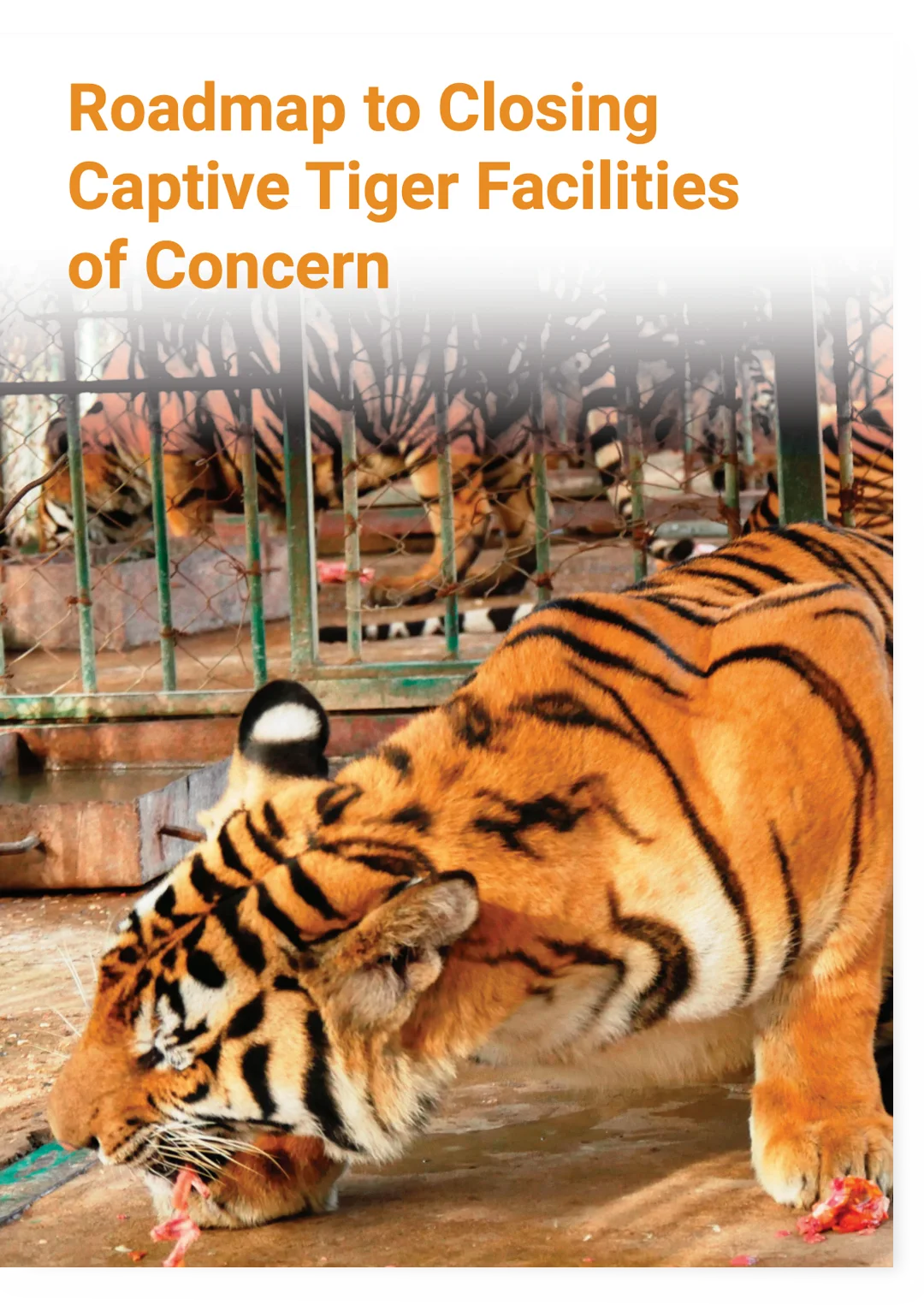
An estimated 8,900 tigers are currently held in more than 300 captive facilities across East and Southeast Asia — more than twice the number of tigers estimated to remain in the wild. The rate at which tigers are bred, traded from one facility to another, and slaughtered for illegal trade is not known but is believed to be high, accounting for the rapid shifts in estimates of captive tiger populations.
For the purposes of this document, a “captive tiger facility of concern” is a facility that keeps or breeds tigers in captivity with an intent, or reasonable probability, of supplying or directly engaging in the commercial trade in tigers and/or their body parts or derivatives. While these facilities — often referred to as “tiger farms” — have existed since at least 1986, the number of captive tigers has substantially increased over the past 15 years. This highlights the need to stop the breeding of these tigers before monitoring, control, care, and involvement in illegal trade gets even more difficult to manage.
Beyond conservation and animal welfare concerns, tiger farming continues to significantly hinder enforcement efforts aimed at stopping the trade in tiger products. The existence of commercial captive populations can complicate efforts to distinguish legally held animals and products from those originating in the wild. Weak registration, traceability, and oversight can create opportunities for wild-caught tigers or illegally sourced parts to be introduced into captive systems and subsequently enter markets. At the same time, commercial use of captive tigers helps perpetuate and grow consumer demand for tiger products.
Wildlife Justice, together with WWF, Four Paws, Wildlife Conservation Society, Environmental Investigation Agency, and other organisations, developed this Roadmap, to set out practical recommendations for governments to phase- out captive tiger facilities of concern, strengthen monitoring and enforcement, whilst preventing the creation or growth of further such facilities.
The Roadmap calls on States to, in particular, to ensure rigorous enforcement of laws prohibiting the possession of tigers of illegal origin or without registration, as well as the illegal trade in tigers and their parts and products. This is essential to ensure that wild tigers are not laundered through captive breeding facilities.