By Olivia Swaak-Goldman
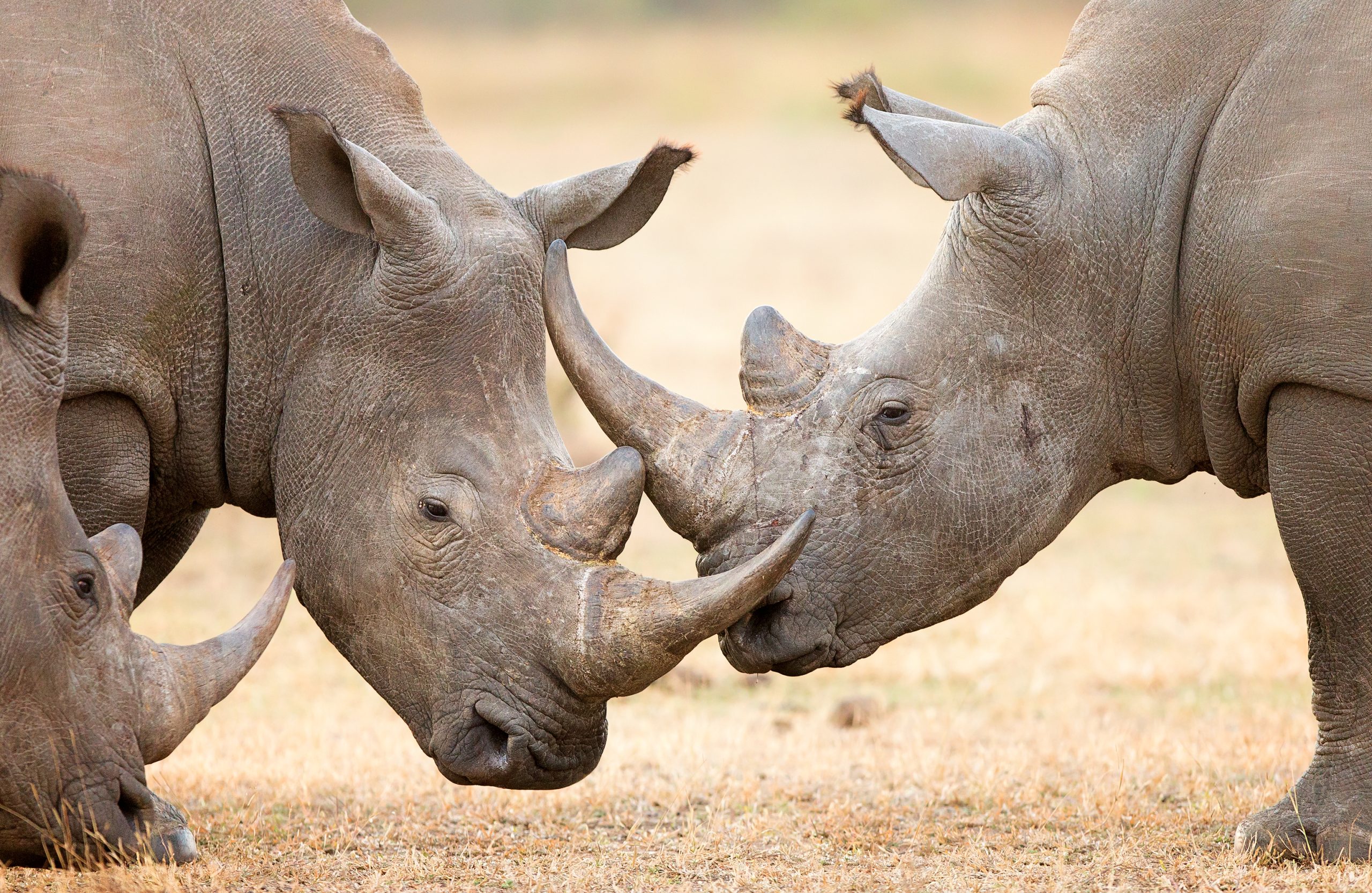
On World Rhino Day, we reflect on the ongoing battle against rhino horn trafficking and celebrate significant victories, while acknowledging the challenges that persist. Rhinos continue to be targeted by transnational criminal networks driven by greed, however recent advancements in law enforcement action, particularly in Southern Africa, offer hope and highlight the importance of international cooperation and robust law enforcement.
Significant convictions: A major blow to rhino horn trafficking networks
This year, Mozambique achieved a major victory in the fight against rhino horn trafficking with the convictions of Simon Valoi, also known as “Navara,” and Paulo Zucula, two of the most notorious figures in the illegal rhino horn trade, as well as Chabane Assuba, a major rhino horn supplier and trafficking facilitator. On 16 August 2024, Valoi was convicted on multiple charges: 16 years for illegal wildlife trade, 8 years for criminal association, and 16 years for money laundering. Valoi received a 27-year sentence, along with fines equivalent to 16 years, totalling approximately 170,000 USD in compensation to the state, and the confiscation of assets worth approximately 140,625 USD. Zucula was sentenced to 24 years, with fines for 16 years, totalling approximately 62,500 USD in compensation to the state, and assets worth approximately 265,625 USD seized. Assuba was convicted earlier on 21 March 2024 on wildlife trafficking, money laundering and criminal association charges, and sentenced to 30 years imprisonment and fines equivalent to two years.
These convictions, following their arrests in two separate operations in 2022 by Mozambique’s Serviço Nacional de Investigação Criminal (SERNIC) with the support of the Wildlife Justice Commission, mark a decisive blow against wildlife trafficking networks across Southern Africa. Assuba worked with several major global criminal networks to supply rhino horns and facilitate shipments of wildlife products to Asia. Valoi, a prolific rhino poaching boss, was known for primarily targeting South Africa’s Kruger National Park. His arrest and subsequent conviction, along with that of his right-hand man Zucula, represent a significant disruption to illegal wildlife trade in the region. The high sentences handed down to these criminals send a strong and clear message: involvement in the illegal rhino horn trade will lead to severe consequences.
Shifts in poaching dynamics: From Kruger National Park to new hotspots
From around 2008 to 2021, Kruger National Park was the epicentre of rhino poaching in Africa, but data since 2022 indicates a shift in poaching activity to other parks and provinces within South Africa, particularly KwaZulu-Natal’s Hluluwe-iMfolozi National Park, and to other countries in Southern Africa such as Namibia and Botswana. The disruption of criminal networks targeting Kruger (such as Valoi’s network) may have contributed to this geographic displacement, though the decline in rhino numbers within Kruger also plays a role.
Despite these shifts, rhino poaching remains a serious issue. In 2023, 499 rhinos were poached in South Africa alone, an 11% increase from the previous two years. This ongoing poaching activity underscores the need for continued vigilance and adaptive strategies in combating these criminal networks.

Figure 1: Displacement of the primary rhino poaching threat in South Africa to KwaZulu-Natal Province, based on data reported by DFFE.
Global reported rhino seizures have significantly declined
Despite rhino poaching rates continuing with a slightly increasing trend over the last three years, there has been a sharp drop in reported rhino horn seizures globally. Both the number of seizure incidents and the amount of rhino horn seized have continually declined since 2021, reaching near-zero levels compared to the global peak in 2019. The apparent lack of seizures compared to the ongoing large quantities of poached horns that are available for illegal trade raises many questions. It is a major intelligence gap and a concerning trend, which could suggest that either more rhino horn consignments are being successfully shipped undetected, that seizures are being made but are not being publicly reported, or that rhino horn stockpiles are being amassed.

Figure 2: Global reported rhino horn seizures from 2012 up to September 2024, based on data collection from open-source reports.
Persistent challenges: The role of corruption and emerging trafficking routes
Corruption continues to play a significant role in enabling rhino horn trafficking. As highlighted in our Global Threat Assessment on Rhino Horn Trafficking (referred to as the ‘Rhino Report’) published in 2022, corruption permeates every stage of the illegal wildlife trade, from poaching to transportation and sale. Tackling this insidious issue requires coordinated international efforts and stronger regulatory frameworks to remove the corrupt elements that facilitate wildlife crime.
Moreover, the displacement of criminal activity to new regions, such as the use of Angola as a gateway for trafficking rhino horn and ivory to Asia, and the emergence of Portugal as a transit country of interest, presents new challenges. This shift in trafficking routes underscores the need for a cohesive global response to prevent criminals from exploiting vulnerabilities in different countries.
Building capacity in Mozambique: A critical frontline in the fight against wildlife crime
Mozambique plays a significant role in the poaching and trafficking of wildlife, particularly within the Great Limpopo Transfrontier Conservation Area (GLTFCA), which spans parts of Mozambique, South Africa, and Zimbabwe. Criminal networks based in Mozambique are key players in the illegal trade, using the country as a major exit point for ivory and rhino horn destined for Asia.
Recognising the critical need to strengthen law enforcement capabilities in Mozambique, the Wildlife Justice Commission has been actively involved in capacity-building initiatives. Over the past five years, we have forged a strong partnership with SERNIC, aimed at disrupting and dismantling transnational criminal networks engaged in wildlife trafficking. Together, we have played a pivotal role in combatting organised wildlife crime, with SERNIC showing unwavering dedication to tackling wildlife crime at large, and rhino horn trafficking in particular, to safeguard endangered species and preserve the region’s biodiversity.
With the support of the Svenska PostkodLotteriet Stiftelse (Swedish Postcode Lottery Foundation), the Wildlife Justice Commission has been able to support SERNIC particularly in maximising the effectiveness of the Control Centre we helped establish. Their support has also enabled us to provide advanced training and mentoring for SERNIC staff at key locations.
Furthermore, supported by the United Kingdom Government through the Illegal Wildlife Trade Challenge Fund, our work in Mozambique has also included targeted training and mentoring in intelligence analysis and investigations. Through “Train the Trainer” programs and on-the-ground mentoring, we have empowered SERNIC officers across multiple provinces, including Maputo, Sofala, and Nampula to take decisive action against wildlife crime.
These initiatives are part of a broader strategy to disrupt the criminal networks exploiting Mozambique as a key transit point. The convictions of Valoi, Zucula and Assuba are a testament to the effectiveness of these combined efforts, showing that with strengthened law enforcement, community engagement and political will, significant blows can be dealt to those who threaten the world’s wildlife.
Strengthening global cooperation to combat rhino horn trafficking
While progress has been made, the fight against rhino horn trafficking is far from over. The Wildlife Justice Commission remains committed to supporting global partners in their efforts to dismantle the criminal networks that threaten the survival of rhinos.
However, the ongoing threat of rhino poaching and trafficking requires a sustained and coordinated international response. One of the key recommendations of the Rhino Report was that rhino horn trafficking needs to be addressed as transnational organised crime. The illegal killing of rhinos and trafficking of their horns is a global criminal enterprise, comprising multiple criminal components dominated by greed and the pursuit of substantial profits. By leveraging intelligence-led investigations, bridging intelligence gaps, and urging governments to take decisive action, we can continue to make headway in protecting one of the world’s most iconic species.
Together, we can ensure that rhinos have a future in the wild, free from the threat of poaching and trafficking.