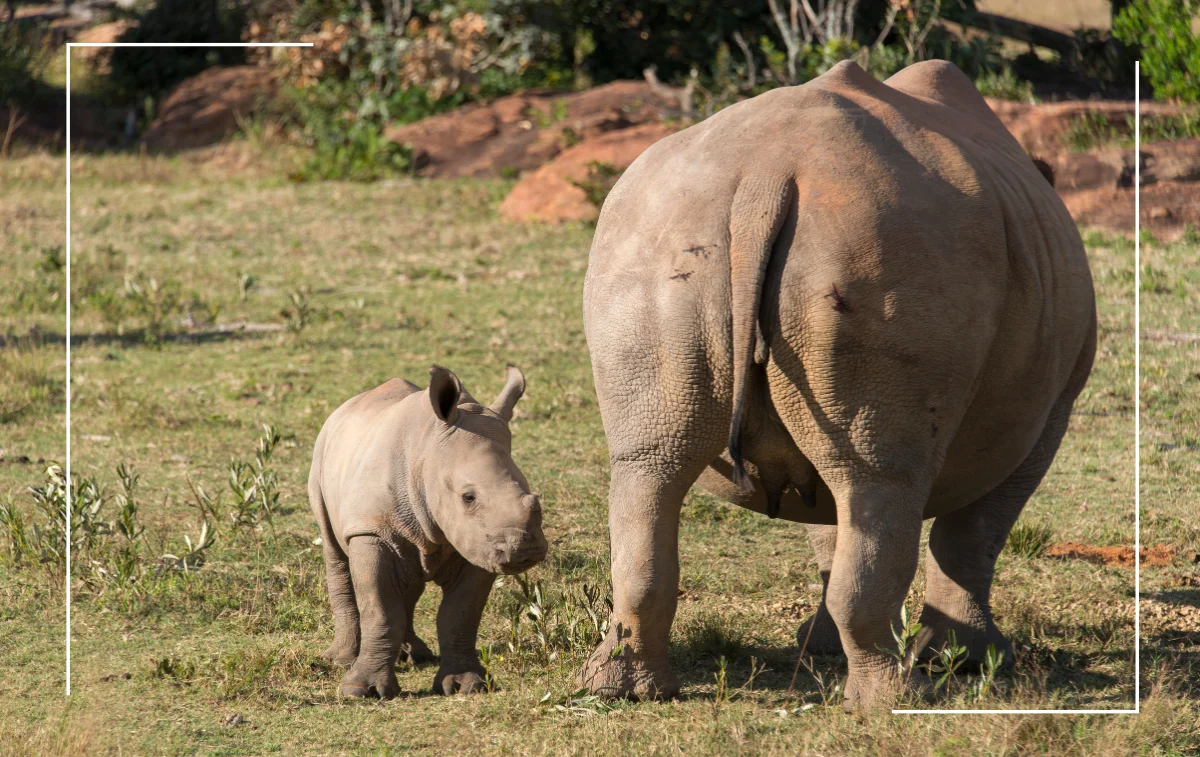
Wildlife trafficking remains one of the most urgent threats to biodiversity today. Across continents, it undermines governance, fuels corruption, and drives species closer to extinction. While many species are trafficked, few are as prominent—or as endangered—as rhinos. Rhino horn trafficking is a form of organised crime, with sophisticated transnational networks linking poaching in Africa to consumer markets in Asia.
The Wildlife Justice Commission (WJC) works alongside law enforcement authorities to investigate and prosecute these criminal networks. Our intelligence-led investigations are the main engines driving this work: the WJC infiltrates criminal networks, maps trafficking chains, exposes key actors, and provides actionable intelligence that supports enforcement.
The WJC’s investigations help generate on-the-ground insights into rhino horn trafficking trends. Below is the latest data on rhino poaching and rhino horn seizures, as well as insights and analysis current as of September 2025.
Persistent poaching threats and evolving dynamics
In 2022, the WJC published Rhino Horn Trafficking as a Form of Transnational Organised Crime, 2012–2021, a comprehensive threat assessment. It found that rhino horn trafficking had become a highly organised transnational crime, dominated by a few key source, transit, and destination countries. Today, rhino populations remain under serious pressure from organised crime networks.
South Africa continues to be the epicentre of the crisis: it is reported to hold 54% of the global rhino population and accounted for 82% of rhinos poached across African range states in 2024.
- 2024: 420 rhinos were reported poached in South Africa—a 16% decrease from 2023. While this decline is notable, more than 400 rhinos have been killed in the country annually since 2020, underscoring the persistence of the problem.
- 2025: Early data indicate 103 rhinos were killed in the first quarter of this year alone, with 65 poached in national parks. KwaZulu-Natal (KZN) and Kruger National Park remain the hardest-hit areas.
Poaching displacement illustrates the adaptability of criminal groups. In the first six months of 2024, KZN accounted for around twice as many rhino poaching incidents compared to Kruger. By 2025, the trend appears to have reversed, with Kruger accounting for the majority of recorded cases, showing how networks shift operations in response to enforcement.

Dehorning programmes introduced in KZN in mid-2024 have shown some promise, serving as a partial deterrent to poachers. Yet the measure is far from a silver bullet. Dehorned rhinos continue to be killed by poachers. In addition, horns regrow within two to three years—necessitating repeated interventions—and the practice contributes to growing national horn stockpiles, which carry the risk of leakage into the illegal trade.
Global seizure trends
Globally, the quantity of rhino horn seized peaked in 2019. While seizure volumes are now 90% lower than the 2019 peak, they have escalated this year:
- 2022–2023: Successful enforcement operations—including the arrests of rhino poaching boss Simon Valoi in Mozambique and high-level trafficker Phan Viet Chi in Nigeria—significantly disrupted trafficking. Seizures dropped, reflecting both suppressed network activity and traffickers’ increased caution.
- 2024: Reported seizures remained low, particularly in comparison to relatively steady rhino poaching rates. This discrepancy could point to intelligence gaps, stockpiling, and the growing sophistication of organised crime groups.
- 2025: The volume of significant seizures has more than tripled compared to 2024, though still below 2021–2022 levels. This suggests networks could be regaining confidence, investing in larger consignments, and taking greater risks. Two seizures this year weighed over 30 kg each—whereas there were no seizures exceeding 30 kg in 2023 and 2024. This may be an early indicator of renewed confidence in logistics and an increasing appetite for financial risk.

These trends underscore the need for the WJC and partners to step up intelligence-led enforcement and sustained pressure on high-level traffickers to prevent the resurgence of these networks.
Shifting trafficking routes and methods (2024-2025)
Trafficking routes and methods are constantly shifting in response to enforcement pressure and other dynamics. Analysis of reported seizure data indicates the following recent trends:
- Mozambique and Angola are key exit points for rhino horn leaving Africa.
- Air passenger and cargo routes remain the dominant transport methods.
- Vietnam, China, and Lao PDR are key entry points into Asia, with Thailand emerging as a new transit point, and Qatar and the United Arab Emirates continuing as key transit hubs.
- Intelligence collected during WJC investigations suggests that syndicates, particularly Vietnamese and Chinese, are demonstrating greater caution and sophistication, adapting concealment techniques and exploiting corruption vulnerabilities.
These 2025 findings mark a shift from the trafficking dynamics observed in 2024, as illustrated in the graph below.

These dynamics show that while enforcement creates pressure, networks continually recalibrate, making sustained and targeted disruption efforts essential to combat these crimes.
Disrupting high-level networks
The WJC’s experience shows that targeted enforcement can deliver systemic disruption of the criminal networks trafficking rhino horn. Recent cases illustrate that when high-level traffickers are investigated, arrested, prosecuted, and convicted with proportionate sentences, networks can be disrupted across multiple countries. In recent years, WJC investigations contributed to several landmark cases:
- Simon Valoi (aka “Navara”): One of the most notorious rhino poaching bosses in southern Africa, suspected to be responsible for at least several hundred rhino deaths in South Africa. The WJC supported the National Criminal Investigation Service (SERNIC) of Mozambique with an intelligence-led investigation into Valoi, resulting in his arrest in 2022 and conviction in 2024 on charges of wildlife trafficking, criminal association, and money laundering. He was sentenced to 27 years’ imprisonment.
- Phan Viet Chi: A Vietnamese national, he led a major trafficking network spanning South Africa, Mozambique, Nigeria, and Vietnam. The WJC supported the Nigeria Customs Service in an intelligence-led investigation, and in May 2022 Chi and his two lieutenants were arrested in Nigeria for trafficking 7.1 tonnes of pangolin scales and 850 kg of ivory. The WJC’s analysis of Chi’s seized mobile phones led to further arrests in Mozambique, including of his senior broker. In July 2023, Chi was convicted in Nigeria, while in March 2024 his senior broker was convicted in Mozambique and sentenced to 30 years’ imprisonment for illegal possession of wildlife products, criminal association, and money laundering.
- Teo Boon Ching (aka “the Godfather”): A Malaysian national, “the Godfather” was a high-level global transporter of wildlife shipments. Intelligence indicates he controlled transport networks from around 2014, moving wildlife products across Africa and Asia and using Malaysia as a transit hub. In June 2022, Ching was arrested by the Royal Thai Police in a joint operation with the U.S. Fish and Wildlife Service, supported by the WJC. He was extradited to the U.S. in October 2022 to face charges of conspiracy to commit wildlife trafficking and money laundering. In September 2023, he was sentenced to 18 months’ imprisonment for conspiring to traffic at least 219 kg of rhino horn.
These cases demonstrate that targeting high-level traffickers can lead to significant disruption of transnational networks. At one stage, rhino poaching trends in Kruger reflected this impact, showing a displacement of criminal activity to other regions, even though patterns have since shifted. Pangolin trafficking in Nigeria was also significantly disrupted, with no seizures at Asian seaports originating from Nigeria in over three years. They also show how intelligence-led approaches, cross-border and multistakeholder cooperation, and the application of money-laundering and criminal association charges can enhance outcomes beyond traditional wildlife crime cases.
Lessons for enforcement and policy
Recent data on the illegal rhino horn trade demonstrates that wildlife trafficking networks are resilient, but also vulnerable to targeted disruption. Strategic and consistent law enforcement efforts are essential to create deterrence. Key takeaways include:
- Intelligence is critical: Intelligence-led approaches remain the most effective way to disrupt high-level traffickers. Mapping networks, identifying key actors, and tracking changes in trafficking methods enable law enforcement authorities to focus scarce resources where they can deliver the greatest impact.
- Leverage multilateral legal frameworks: Frameworks such as the UN Convention against Transnational Organized Crime (UNTOC) and the UN Convention against Corruption (UNCAC) provide critical legal tools. UNTOC enables countries to classify wildlife trafficking as serious organised crime, unlocking the use of advanced investigative techniques, mutual legal assistance, and extradition. UNCAC provides mechanisms to address the corruption that traffickers exploit at ports, airports, and within enforcement agencies. States should incorporate these conventions into their legal frameworks, apply them to wildlife, harmonise penalties across jurisdictions, and use them as the legal foundation for joint investigations and prosecutions.
- Close gaps in national legislation: Many countries still lack strong penalties for wildlife trafficking or do not classify it as organised crime. Updating laws to criminalise possession, conspiracy, and laundering of wildlife products—and enabling the use of anti-money laundering frameworks—gives prosecutors stronger tools to pursue high-level traffickers.
- Prioritise advanced investigative techniques: Because syndicates use sophisticated criminal methodologies, traditional policing is insufficient. Countries should mainstream the use of special techniques—such as controlled deliveries, covert surveillance, and undercover operations—within serious wildlife crime cases. These techniques, when authorised under national law and supported by UNTOC provisions, are crucial for dismantling organised networks.
- Strengthen international and multistakeholder cooperation: No single country can tackle rhino horn trafficking alone. Recent convictions of high-level traffickers were only possible through coordinated investigations across multiple jurisdictions, supported by NGOs and intergovernmental organisations. Establishing cross-border task forces, embedding liaison officers, and engaging financial intelligence units will increase the speed and effectiveness of joint responses.
- Target financial flows and assets: Organised crime is profit-driven. Pursuing traffickers’ assets through anti-money laundering investigations and recovering the proceeds of crime not only weakens networks but also creates a deterrent effect. Prominent countries affected by rhino horn trafficking should consider wildlife crime in their national risk assessments under the Financial Action Task Force (FATF) framework to ensure anti-money laundering systems are appropriately targeted to identify suspicious transactions and illicit financial flows linked to the trade.
- Address corruption vulnerabilities: Corruption remains the critical enabler of trafficking. Corruption investigations—conducted through joint multiagency task forces involving customs, police, and anti-corruption agencies—should run parallel to wildlife cases. States should also adopt integrity testing, whistle-blower protections, and oversight mechanisms in frontline agencies, particularly customs and border forces.
Conclusion
Rhino horn trafficking trends continue to shift in 2025, reflecting both ongoing enforcement efforts and the resilience of organised criminal networks. While seizures remain lower than pre-pandemic peaks, the recent increase in large consignments may indicate that networks are rebuilding their operations. However, lower seizures in the face of relatively steady rates of rhino poaching could point to intelligence gaps, changed modus operandi, or potential stockpiling.
The lesson is clear: enforcement must evolve as rapidly as the criminal networks do. The WJC remains committed to advancing intelligence-led, high-impact enforcement efforts, disrupting high-level networks, and sustaining pressure on traffickers to reduce poaching and safeguard rhino populations for future generations.